
We’ve already covered what GTPCProxy can do and how it works under the hood. Now let’s move on to practice and walk through four scenarios in which GTPCProxy from VAS Experts makes these changes easier and helps reduce risks for subscribers.
1. Decommissioning the GGSN Without Replacing the SGSN
Many operators know this picture well. LTE has long been served by modern PGW gateways, while the 2G/3G network still runs through a legacy GGSN, the gateway that played the role of the PGW in previous-generation networks. The SGSNs serving 2G/3G subscribers only work with the older protocol version, and modern PGWs can’t act as a GGSN. So without the GGSN, there’s nothing to serve 2G/3G subscribers, and the operator has no plans to replace the SGSNs. The longer the operator runs the legacy GGSN, the harder it becomes to keep it running, find spare parts and maintain compatibility with the current billing system.
GTPCProxy keeps the legacy GGSN and new network nodes interoperating by translating messages between protocol versions. The SGSN keeps using the older version (GTPv1), while the session is served by a modern PGW that only understands the newer one (GTPv2). The proxy translates not just the messages themselves but all of their contents: addresses and tunnel endpoint identifiers (TEIDs), quality of service parameters, subscriber location, the charging identifier and failure causes. Roaming subscribers are handled the same way.
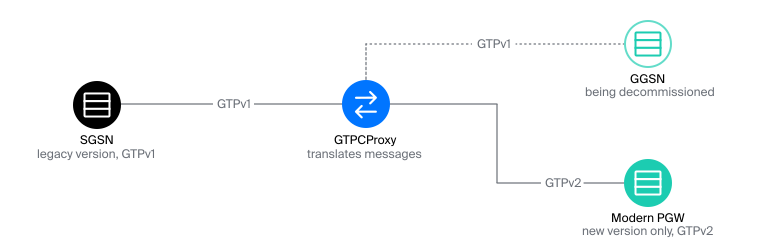
Figure 1: Ensuring compatibility between legacy and new network nodes
While the GGSN is still running, the proxy can route part of the sessions to it. Once the GGSN is switched off, all 2G/3G subscribers will be served by the modern PGW.
Translation is enabled in the pool settings and runs in one of two modes.
- Fallback mode. A session goes to the modern PGW only if gateways with GGSN functionality are unavailable.
- Primary mode. Routing rules send selected subscribers straight to the modern PGW.
Primary mode lets you decommission the GGSN step by step. First, some subscribers are moved to the new gateway, then an entire access point (APN), and only after that is the GGSN taken out of service. Subscribers moving between 2G/3G and LTE keep their sessions throughout.
| Technical details | Description |
| Interfaces | Gn/Gp (2G/3G, GTPv1) and S5/S8 (LTE, GTPv2) |
| What is translated | Addresses and TEIDs, QoS parameters (TS 23.401, Annex E), location, Charging ID, failure causes |
| Roaming | Subscribers connected via Gp |
2. Replacing a PGW Without an Overnight Cutover
Migrating to another vendor’s PGW is usually done all at once. The cutover is scheduled for the night, and a rollback plan prepared in advance makes it possible to restore the previous configuration if problems arise during the migration. With GTPCProxy, a new gateway can be brought in gradually.
Routing rules and pool weights send the desired share of new sessions to the new PGW. Subscribers can be selected by IMSI range, access point (APN) or radio network type. Established sessions stay on the old PGW until they end on their own.
Rules and pools are stored in the routing document, which is the proxy’s configuration. It can be changed without restarting the proxy. The proxy validates the new version before applying it, and you can roll back to the previous one with a single action in the web interface.
If the new PGW starts rejecting sessions or becomes overloaded, the proxy detects this during pool health checks and sends sessions to another gateway in the pool. If a PGW fails completely, its subscribers reconnect to healthy gateways and get new IP addresses. A recovered PGW is brought back into service gradually.
3. Gateways for Partners, MVNOs and M2M
Many operators host mobile virtual network operators (MVNOs), corporate access points or a large M2M customer with its own PGW. These subscribers need to be routed precisely to their gateways. GTPCProxy rules select a pool based on IMSI prefixes and ranges, the access point, the network the subscriber connects through and the radio network type.
The proxy can also modify session parameters, such as the access point, charging characteristics or PDN type. The modified parameters are taken into account when selecting a PGW and passed to the selected gateway. This way, the partner’s PGW receives the parameters in the form it expects, and there’s no need to reconfigure the SGW or MME.
Another criterion is subscriber location. Rules can define up to 64 areas. This is how operators build regional PGW pools and dedicated pools for a mass-event area or for M2M devices in a specific territory.
| What the rule considers | Technical parameter |
| SIM card number (prefix or range) | IMSI |
| Phone number (prefix) | MSISDN |
| Access point | APN |
| Network the subscriber connects through | PLMN |
| Radio network type | RAT Type |
| Location (up to 64 areas) | TAC, ECI, eNB, LAC, CGI, SAI, RAI |
Parameters the proxy can override include APN, Selection Mode, Charging Characteristics, PDN Type and others.
4. Reconnecting to a Gateway in the New Region
A regional PGW works well until a subscriber moves to another region with an open session. The subscriber then keeps working through the old region’s gateway. The proxy learns about the location change from reports sent by the network’s control nodes (the MME and S4-SGSN).
GTPCProxy can terminate such a session using 3GPP standard procedures (TS 23.401). First, it closes the session toward the SGW and MME, then toward the PGW, and asks the device to reconnect. The device then connects to the new region’s pool and gets a new IP address.
It’s best to enable this feature in stages.
- First, enable monitoring mode. The proxy doesn’t terminate anything; it only counts the sessions it would have terminated and shows them in its metrics.
- Then enable session termination itself. For this, you set a rate limit, damping and protection against mass termination when the location of a large number of subscribers changes at the same time.
The proxy leaves some sessions alone. If a subscriber is on a voice call, termination is postponed until the call ends. Emergency and IMS sessions, sessions with a static address and sessions to access points on the exclusion list are never terminated.
Bonus: IMS Sessions Survive an SGW Restart
IMS sessions carry voice calls over LTE (VoLTE). Normally, when an SGW restarts, the PGW learns about it from the changed restart counter (Recovery) and deletes all of that SGW’s sessions, including IMS sessions.
When configured accordingly, GTPCProxy preserves the sessions of a restarted SGW or SGSN so they can be restored according to the 3GPP standard. By default, sessions are kept for 3,660 seconds, or about an hour. As a result, restarting a single SGW doesn’t drop the IMS sessions that VoLTE runs on.
Summary
None of the four scenarios requires changes to the MME, SGW, SGSN or PGW. All it takes is adding DNS records for the relevant access points. The proxy works with all nodes according to 3GPP standards, and all rules are stored in a single routing document.
VAS Experts offers to test protocol translation and region-change session termination in the operator’s own lab, on its own nodes. The lab validation package includes configurations, scenarios, a rollback procedure and a report template. Contact us, and we’ll select scenarios tailored to your network.