

PCRF Offload

Offload your PCRF without replacing or stopping the network

What is PCRF Offload and why do operators need it?

PCRF Offload is a practice of moving part of the decision-making logic and Diameter/Gx message processing to an intermediate node (proxy) to reduce the load on the main PCRF.

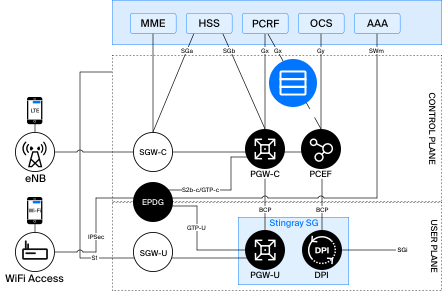
The PCRF Proxy is embedded transparently in the break of the Gx interface between the PCEF and the PCRF, with no modification to existing equipment, and helps when:

  • a heavily loaded PCRF can’t keep up with subscriber base/traffic growth
  • replacement or an upgrade from the vendor requires months of approvals and high CAPEX
  • there is a risk of Gx session degradation and PCRF failure under peak load.

Why can the PCRF become a bottleneck?

Growing signaling load

Growth in the subscriber base, IoT devices, and Gx/Gy sessions overloads a PCRF sized for smaller volumes.

HOL blocking in Diameter

Diameter's TCP transport creates Head-of-Line blocking – delays in one session slow down the processing of the rest.

Long and costly modernization

Upgrading or expanding the capacity of a legacy PCRF means months of approvals, integration, and a significant budget.

Risk of service degradation

PCRF overload leads to authorization delays, billing failures, and degraded subscriber QoE.

How PCRF Proxy offloads the existing PCRF

The PCRF Proxy is embedded transparently in the break of the Gx interface between the PCEF and the PCRF – both elements continue to operate normally and require no modification.

Part of the requests and decisions are processed at the proxy level (policy caching, local routing, reusable rules) without querying the PCRF for every event. A Diameter bridge converts TCP sessions into multi-threaded SCTP (multistreaming), eliminating HOL blocking and increasing the throughput of the signaling path.

Gx traffic can also be routed and balanced across several PCRFs/directions to reduce peak load on the main node.

PCRF Offload based on PCRF Proxy

How PCRF Offload is deployed

Signaling load audit

Analysis of current PCRF load, Gx session volume, and degradation points.

Embedding PCRF Proxy into the Gx break

Installation without stopping the network and without changes to the PCEF/PCRF.

Configuring offload rules

Defining which types of requests and policies are handled at the proxy, and which are passed through to the existing PCRF.

Monitoring and load balancing

Real-time monitoring of the reduction in PCRF load, fine-tuning of routing rules.

What PCRF Offload delivers to the operator

Deployment in 1 day: no network downtime, no PCEF/PCRF modifications, no need to involve the existing system's vendor.

Extended PCRF lifespan: reduced load postpones the need for a costly replacement/upgrade.

Elimination of HOL blocking: Diameter bridge with TCP → multi-threaded SCTP conversion.

Lower CAPEX/OPEX: no need to buy a new PCRF or expand vendor licenses.

Gx interface fault tolerance: load balancing and redundancy of the signaling path.

No vendor-lock: compatible with products from any mobile network solution vendor, works in the cloud and on-premise.

Why PCRF Offload instead of replacing or upgrading the PCRF?

Criterion
Vendor PCRF replacement/upgrade
Stingray PCRF Proxy
Deployment speed
Months of approvals and integration
1 day
Equipment modification
Required
Not required
Costs
Significant CAPEX
Minimal
Diameter HOL blocking elimination
Not guaranteed
Built in
Dependence on the PCRF vendor
High
None

When is PCRF Offload relevant?

Operators with a legacy PCRF that can't keep up with the current volume of subscribers/traffic.

Networks where replacing the PCRF with the original vendor is economically unviable or technically difficult (vendor exiting the local market, end of product support).

Operators preparing for load growth (new tariff plans, M2M/IoT, MVNO partners) without an immediate core upgrade.

Networks with frequent Gx session degradation due to HOL blocking in Diameter.

Request a demo

Fill in the form
We will contact you, specify the task, provide access to the documentation and answer your questions.
Choose the solution
We discuss the current situation: traffic volume, available equipment, the functionality you need.
Free trial
Our engeniers install the selected software and adapt it to your specific tasks. Сontract — only after the test is successful.

FAQ

How does PCRF Offload differ from replacing or upgrading the PCRF?
PCRF Offload doesn't replace the existing PCRF – it reduces the load on it: part of the Diameter/Gx requests are processed at the intermediate PCRF Proxy node. This avoids buying a new PCRF, vendor integration, and network downtime, unlike a classic upgrade, which takes months.
What are the infrastructure requirements for deployment?
PCRF Proxy is deployed on a standard x86 server and supports bare-metal, virtualization (VM), and containerization. Minimum configuration: 4 vCPU, 16 GB RAM, 100 GB disk for a load of up to 10,000 sessions. The solution works both in the cloud and on-premise, including in an isolated environment with no internet access.
Does deploying PCRF Offload require stopping the network or modifying the PCEF/PCRF?
No. PCRF Proxy is embedded in the break of the Gx interface between the PCEF and the PCRF as a transparent node – the equipment continues to operate normally without modifications.
How does PCRF Proxy behave in the event of a failure?
If the PCRF Proxy node fails, traffic switches directly to the existing PCRF, which prevents a complete stop of session authorization. Clustering is available for mission-critical networks to eliminate a single point of failure.
How does PCRF Proxy integrate with the operator's monitoring and NMS?
Load metrics, statistics on proxied requests, and Gx session status are available via SNMP and Zabbix for integration with an external monitoring system. A built-in dashboard shows the reduction in PCRF load in real time.
How long does deployment take and what stages does it consist of?
Deployment takes place in four stages: signaling load audit, embedding PCRF Proxy into the Gx break without stopping the network, configuring offload rules (which requests the proxy handles, which go to the PCRF), and monitoring with routing fine-tuning. The deployment itself takes 1 day; further tuning of offload rules takes from several days depending on network complexity.
How is PCRF Proxy licensed – by subscriber, by traffic, or by node?
Licensing depends on the scale of the network and is tailored individually to the volume of Gx sessions and the required fault tolerance. VAS Experts engineers calculate the exact model and cost after a signaling load audit – submit a request on this page to get a calculation for your network.
Do I need to expand the license for my existing PCRF vendor?
No, and that's the economic point of the solution. PCRF Offload reduces the number of requests reaching the legacy PCRF, so there's no need to expand licenses or capacity with the original vendor. Only the PCRF Proxy itself is licensed, through VAS Experts.
Who is PCRF Offload for, and when should it be deployed?
The solution is relevant for operators whose legacy PCRF can't handle current load, where replacing the PCRF with the original vendor is economically unviable (import substitution, end of support), or whose network is preparing for traffic growth (new tariff plans, M2M/IoT, MVNO partners) without an immediate core upgrade. It also applies to networks with frequent Gx session degradation caused by HOL blocking in Diameter.