


SGi Router banner

SGi Router

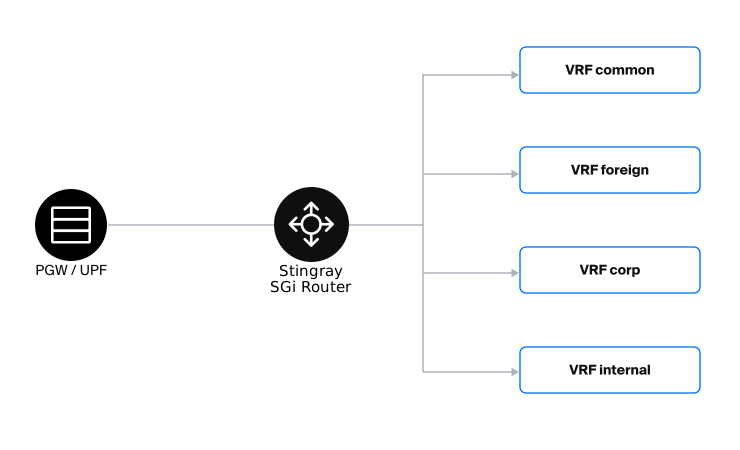
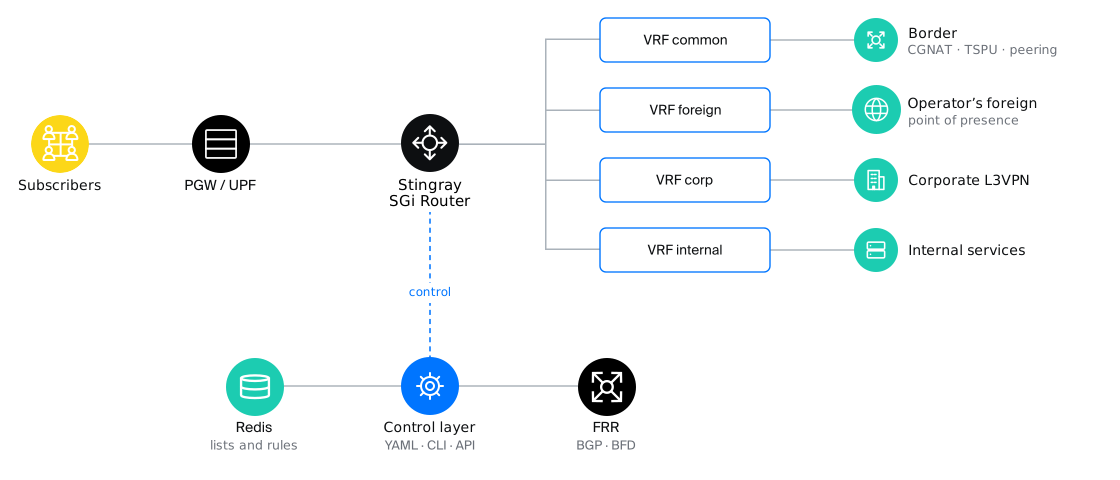
Subscriber traffic routing to the appropriate VRF on the SGi interface based on the subscriber IP pool, destination address, and SNI.

About the Solution

Stingray SGi Router is a software-based router built on the Stingray DPI platform. It selects a VRF for each flow based on the subscriber IP pool, destination IP prefix, and server name (SNI).

The solution enables operators to manage routing within their networks, separate traffic for different subscriber groups, and provide dedicated egress paths for selected services. When a VRF is selected, the traffic route changes while the subscriber and server IP addresses remain unchanged.

SNI-based routing does not require TLS termination. Traffic that does not match any rules follows the default route without state tracking (stateless) or TCP proxying.

Tasks Stingray SGi Router Solves

Dedicated Exit Points for Selected Services

Routing traffic to services through operator-defined uplinks by domain names and IP prefixes.

Separation of Internal and External Resources

Dedicated routes for the operator's internal services, including IMS, portals, and caches, and for external traffic.

Corporate APN Isolation

Corporate traffic is placed in separate VRFs, with the option to define SNI-based exceptions for specific services.

MVNO and M2M/IoT Traffic Separation

Dedicated egress points for mobile virtual network operators and isolation of traffic from different M2M/IoT platforms.

Routing to CDN Caches and Peering

Direct egress of traffic to specified IP prefixes through the corresponding VRFs.

SGi-LAN (Gi-LAN) Service Chains

Directing traffic to the required service chain based on SNI and IP prefix.

How Stingray SGi Router Works


The solution determines the route based on three key criteria:

  • Subscriber pool or APN – defines the applied routing policy.
  • Destination IP prefix – allows traffic to be directed to the required VRF without inspecting its content.
  • Server name (SNI) – allows route selection based on the server name in TLS ClientHello and QUIC Initial. The Host header is also supported for HTTP.

Depending on the rules, Stingray SGi Router directs the flow to a VRF, drops it, or terminates the connection (TCP RST).

For QUIC, the decision is made based on the Initial packet. When ECH is used, the following options are available: routing by the public SNI (outer SNI, usually the CDN provider’s name), connection reset, or forwarding via the default route.

Performance

Performance for a single node with 16 CPU, 64 GB RAM, and 2×100 Gb NIC

Packet rate Throughput New TLS/QUIC flows Capacity Latency median/99.9%
25 Mpps 150 Gb/s 390/120 thousand/s 20M sessions 50/300 µs

Deployment Options

Stingray SGi Router supports three deployment options.

Server

A dedicated node with DPDK, 100G/200G NICs, hugepages, and NUMA pinning.

VNF

A virtual machine on KVM/OpenStack with SR-IOV or PCI passthrough support, hugepages, and vCPU pinning.

CNF

The data plane in Kubernetes using Multus, the SR-IOV device plugin, hugepages, and the static CPU manager. Installation via Helm chart, monitoring, and rolling updates are supported.

Advantages of Stingray SGi Router

No TLS Termination

Route selection by SNI does not require terminating the TLS connection on the router.

Minimal Overhead for Default Traffic

Flows that match no rules follow the default route, stateless and without TCP proxying. Flows that match rules receive additional processing. For TCP connections that a matched rule directs to a separate VRF, the router itself completes the TCP handshake (SYN proxy), reads the SNI, and opens the connection to the server through that VRF. Traffic on the default route is not proxied.
Scaling with Load

Scaling with Load

Performance grows by adding workers and nodes. Horizontal scaling across pairs and sites is supported, as well as active/active mode with address pool distribution across nodes.

High Availability

A pair of nodes with BGP and BFD (BIRD router) provides failover to the backup route on failure. Health checks for the data plane, interfaces, and configuration allow routes to be automatically withdrawn when a node degrades.

Management and Monitoring

YAML, CLI, and HTTP API are available for management. Prometheus metrics and Grafana dashboards provide visibility into operation by policies, rules, and VRFs. Features include flow diagnostics, rule validation without applying it, hot replacement of lists without stopping processing, atomic configuration apply with automatic rollback on error, and a web interface with read/write roles.

Request a Free Stingray SGi Router Demo

Fill in the form
We will contact you, specify the task, provide access to the documentation and answer your questions.
Choose the solution
We discuss the current situation: traffic volume, available equipment, the functionality you need.
Free trial
Our engeniers install the selected software and adapt it to your specific tasks. Сontract — only after the test is successful.