What Is SGW
The Serving Gateway can be thought of as an intermediate node between the radio access network and the rest of the EPC. LTE subscriber user traffic passes through the SGW: data from the device is transmitted through the eNodeB to the SGW, and then routed through the PGW to the external network.
The SGW also links the LTE network with other mobile access technologies. For example, when interacting with the SGSN, it takes part in transferring the user session between 3G and 4G networks.
The Role of SGW in the LTE Network
The Serving Gateway is part of the EPC (Evolved Packet Core) — the packet core of the LTE network. It sits between the eNodeB base stations and the PGW (PDN Gateway).
The typical path of user traffic looks like this:
UE → eNodeB → SGW → PGW → external IP network
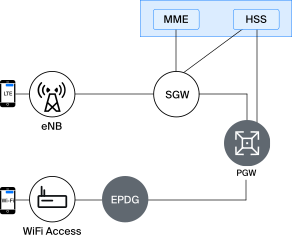
Figure 1 — SGW within the LTE network
Here, UE is the subscriber device, eNodeB is the LTE base station, and PGW provides the mobile network’s connection to the internet and other external IP networks.
How SGW Works
When a device connects to the LTE network, GTP tunnels are created between the network nodes. The subscriber’s IP packets are transmitted through these tunnels.
GTP-U (GPRS Tunneling Protocol — User Plane) is used for user traffic. Control information is transmitted using GTP-C (GPRS Tunneling Protocol — Control Plane). For example, the SGW exchanges signaling messages with the MME (Mobility Management Entity) over the S11 interface.
As a result, the SGW is involved both in transmitting data and in managing the tunnels through which that data passes.
In networks that support LTE and 3G interworking, the SGW also interacts with the SGSN (Serving GPRS Support Node). This makes it possible to maintain subscriber mobility between networks of different generations.
What the Serving Gateway Does
The functions of the SGW are primarily related to user traffic transmission and mobility:
- transferring traffic between the eNodeB and the PGW;
- creating, modifying, and deleting GTP tunnels;
- supporting subscriber mobility between base stations;
- buffering packets in certain mobility scenarios;
- recording transmitted traffic for subsequent billing;
- interacting with the SGSN to support mobility between 3G and LTE.
SGW and Handover
The SGW plays an important role when a subscriber moves between base stations.
For example, a user is watching video on a smartphone and moves from one LTE cell to another. The base station changes, but the data transmission itself should not have to start over. During handover, the network reroutes the user traffic path through the new eNodeB, and the SGW takes part in switching the GTP tunnels.
Thanks to this, an active session can continue when the base station changes, without the need to re-establish a connection with the external network.
SGW vs. PGW: What’s the Difference
SGW and PGW perform different functions within the EPC. The SGW transmits traffic inside the mobile network, while the PGW connects the EPC to external IP networks.
| Characteristic | SGW (Serving Gateway) | PGW (PDN Gateway) |
| Main task | Transmitting traffic within the EPC and supporting mobility | Connecting to external IP networks |
| Main position in the traffic path | Between the eNodeB and the PGW | Between the EPC and the external network |
| Mobility handling | Yes | Limited, within its own role |
| GTP-U | Yes | Yes |
| Internet connection | Via the PGW | Provides the outbound connection |
In some implementations, the SGW and PGW functions may reside on a single physical or software node, but at the level of the EPC architecture they are distinct network functions.
You can learn more about the gateway part of the packet core in the article on PGW and Stingray’s solutions for mobile networks.
Why an Operator Needs SGW
For a mobile operator, the SGW is one of the key elements of the LTE user plane. A significant volume of subscriber traffic passes through it, so the gateway must support high throughput and a large number of simultaneous sessions.
The SGW architecture must also account for scalability and fault tolerance. As the number of subscribers grows, the operator needs to expand core performance without disrupting already established connections.
Technical FAQ
What is SGW in LTE?
SGW (Serving Gateway) is a user-plane gateway in the LTE/EPC architecture. It transmits traffic between the eNodeB and the PGW and helps ensure subscriber mobility.
How does SGW differ from PGW?
The SGW handles traffic transmission within the EPC and supports subscriber mobility, while the PGW connects the mobile network to external IP networks and provides subscribers with access to the internet and other networks.
Which protocol does SGW use?
For transmitting user traffic, the SGW uses GTP-U. GTP-C is used for control procedures, including interaction with the MME over the S11 interface.
Why is SGW needed during handover?
The SGW takes part in switching user traffic as a subscriber moves between base stations. This makes it possible to preserve an active data transmission session while the device is moving.