



PCEF – Policy & Charging Enforcement for Mobile Operators

PCEF (Policy and Charging Enforcement Function) enforces quality of service (QoS) policies and flexible billing based on various conditions as required by the PCRF.

SSG PCEF solution provides carriers with powerful tools to ensure high-quality service and effective revenue management:

  • Enables innovative pricing plans, data usage control and policy enforcement to maintain high quality and revenue protection across any combination of access technologies.
  • Addresses the unique and dynamic needs of prepaid, postpaid, business and IoT customers through seamless integration with service delivery and billing systems.
  • Helps fixed, mobile and converged service providers deploy differentiated and profitable network services by consistently delivering the quality of experience (QoE) that every subscriber expects.
  • Provides marketing statistical reports on user behavior and billing information.


Benefits of SSG PCEF

Simple integration of PCRF, OCS, OFCS

Full support for prepaid, postpaid, business users and IoT device customers.

Rapid deployment and assessment of service demand

Prompt launch of new tariffs with subsequent assessment of their popularity and demand among subscribers.

Revenue enhancement and protection

Optimize sales of value-added services, monetize access points, customize user experience and protect against fraudulent activity.

A tariff plan can be formed by combining different tariff offers:

  • Prepaid or postpaid;

  • Internet distribution (on/off);

  • Internet is available on your smartphone or anywhere;

  • Internet for modem;

  • Messenger Unlimited tariff;

  • Unlimited Music” tariff;

  • Tariff “Social Networks”;

  • Online Movie tariff;

  • Navigation in roaming;

  • Tariff package (day/week/month, etc.) or unlimited;

  • Roaming restrictions;

  • Notification of package end;

  • Weekdays/weekends/holidays.

PCEF in mobile network

How it works

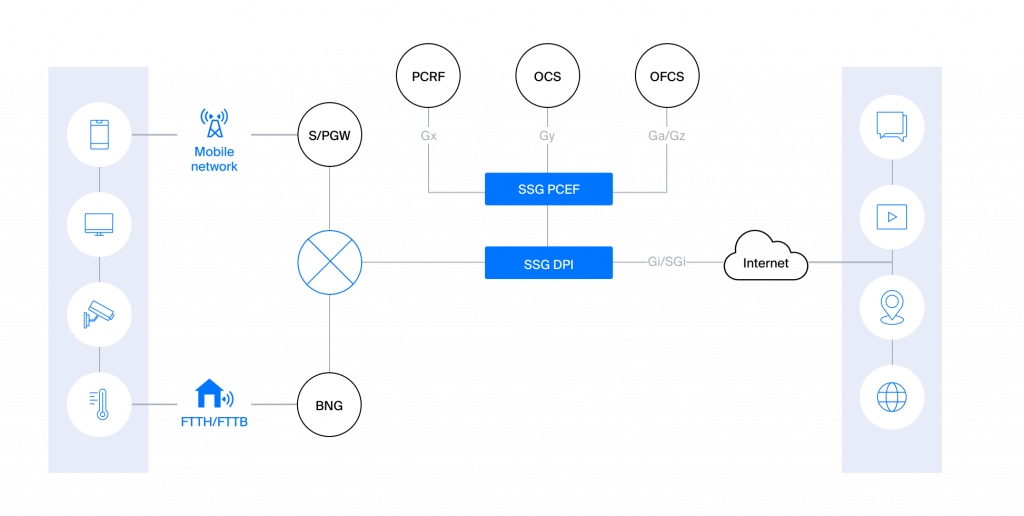
The SSG PCEF connects to the service provider’s network on the Gi/SGi interface and communicates with the following operator systems:

  • Mobile Network Core (GGSN/PGW) on the Gi/SGi interface.
  • PCRF service policy management module on the Gx interface.
  • Module of online charging of subscriber traffic on the Gy interface.
  • Module of offline charging of subscriber traffic on Ga/Gz interface.

Configuration management is performed through the command line (CLI) or through the system web interface (Web UI).

PCEF in mobile networks diagram

FAQ

What is PCEF and why does an operator need it?
PCEF (Policy and Charging Enforcement Function) is a functional node that applies charging and QoS policies received from the PCRF over the Gx interface to subscriber traffic in real time. PCEF is the element that physically limits speed, blocks or allows traffic, counts the volume of data transferred per service, and passes this data to billing via Gy/Gz. Without PCEF, the rules defined in the PCRF remain only "on paper" — there is nothing on the network to enforce them.
What tariff plans can be built on PCEF from VAS Experts?
Stingray PCEF supports flexible tariffication at the application, traffic category, and subscriber profile level: bundled plans split by service (messengers, social networks, streaming), fair usage policy with automatic shaping once a limit is reached, zero-rating plans for partner services, time- and roaming-dependent rules, as well as daily and hourly promotions. Rule logic is defined through the PCRF, while PCEF guarantees its enforcement on traffic without delay.
How does PCEF integrate with a billing system?
Integration is done through the standard Diameter Gx (PCRF) and Gy/Gz (OCS/billing for online and offline charging) interfaces, which allows Stingray PCEF to connect to most billing platforms without custom development on the operator's side. VAS Experts has proven experience integrating with widely used billing solutions and provides technical support during protocol integration.
How does Stingray PCEF differ from Huawei, Nokia, and Ericsson solutions?
The key differences are vendor independence and speed of adaptation. Foreign PCEF solutions are most often sold only as part of the vendor's full infrastructure stack, and rolling out new tariff rules goes through a long vendor support cycle. Stingray PCEF works on top of the operator's existing network (vendor-agnostic) and integrates with the current billing system without replacing other equipment, while the operator itself can implement changes to tariff logic directly, without waiting for a vendor release. This gives operators a more flexible and predictably timed model for developing tariff products, and reduces dependency on a single infrastructure supplier.
How is PCEF deployed on an operator's network?
Deployment includes several stages: an audit of the current network and billing system, designing the integration scheme, configuring the Gx/Gy interfaces with the PCRF and billing system, pilot testing on a limited subscriber segment, and a subsequent full-scale rollout with monitoring via Stingray NMS. VAS Experts specialists support the project at every stage, from the pilot through post-launch support.
How is Stingray PCEF designed technically?
Stingray PCEF is built on VAS Experts' proprietary DPI engine and a CUPS (Control and User Plane Separation) architecture. The DPI engine provides precise traffic classification by application and protocol, not just by port and IP, which is essential for tariffication by service type. The CUPS architecture allows traffic processing (User Plane) to be scaled independently from policy management logic (Control Plane), providing fault tolerance and flexible capacity growth without network downtime.

Request a demo

Fill in the form
We will contact you, specify the task, provide access to the documentation and answer your questions.
Choose the solution
We discuss the current situation: traffic volume, available equipment, the functionality you need.
Free trial
Our engeniers install the selected software and adapt it to your specific tasks. Сontract — only after the test is successful.