




Turnkey MVNO Launch

Launch new virtual mobile operator together with our technological partners and leading billing vendors

What is an MVNO?

An MVNO is a Mobile Virtual Network Operator that provides mobile services under its own brand without owning any physical network infrastructure. Instead, it leases frequencies, capacity, and network resources from one or more host operators (MNOs), focusing entirely on subscriber-related activities: pricing, customer service, marketing, and product development.

The MVNO market is showing steady growth worldwide. Globally, MVNO subscribers stand at 333 million in 2026 and are projected to reach 438 million by 2030 — an addition of over 100 million subscribers in four years. This is a window of opportunity actively being seized by banks, retailers, and fixed-line operators, who are turning mobile services into a tool for increasing customer loyalty and building ecosystem offerings.

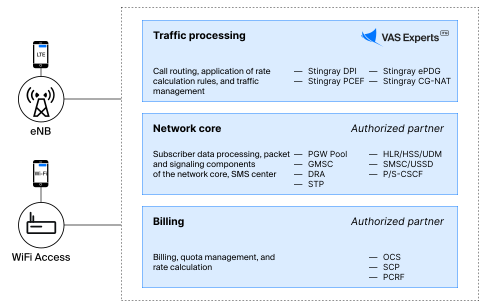
Start infrastructure deployment in the Light MVNO format by leasing resources, or build a Full MVNO with the combined solutions of VAS Experts, our technological partners, and leading billing platforms.

components of mvno turnkey diagram

Why should a business launch its own MVNO?

An in-house mobile virtual network operator can be an important strategic tool for monetizing and growing the core business.

Monetizing your customer base

If you already have a loyal audience (retail network, bank customers, corporate users), an MVNO will allow you to turn it into an additional source of recurring revenue from telecommunications services.

Customer retention and loyalty

A subscriber using your SIM card is much more deeply integrated into the brand’s ecosystem and is less likely to switch to competitors.

Expanding into new market segments

MVNOs provide access to audiences that are difficult to reach through traditional channels: professional communities, geographically dispersed groups, and foreign nationals organized into communities.

Enterprise and industry-specific services

A proprietary network enables you to develop specialized solutions: enterprise plans with centralized management, IoT connections for devices, and location-based services (LBS) powered by location data.

Business models for MVNOs

Virtual network operators operate under several models, which differ in terms of the degree of control over infrastructure, the level of investment, and the speed of market entry.

The easiest way to enter the market. The company sells the host operator’s communication services under its own brand, without managing either the network or pricing. This is suitable for quickly testing demand with minimal investment, but does not provide control over pricing or the customer experience.

The operator manages SIM cards, pricing policies, and customer interactions, while the host operator retains control of the network core. This strikes an optimal balance between speed to market and autonomy – most new MVNOs start with this model, as it provides the most comprehensive understanding of the business’s potential.

A fully-fledged, independent infrastructure: proprietary network core (EPC/5GC), billing, PCRF, OCS, HLR/HSS. This provides maximum control over services, pricing, and quality of service. It requires a higher initial investment but ensures independence from the host operator and the ability to connect to multiple MNOs simultaneously.

A technology platform that provides infrastructure and services to multiple MVNOs simultaneously. An MVNE does not interact directly with end subscribers; instead, it provides other operators with billing, core network services, management interfaces, and support. This model is suitable for companies planning to support multiple brands or build their own MVNO platform.

Three key steps to launching an MVNO

Define your MVNO type

The first step is choosing a business model, which determines the implementation plan and investment size. The Light MVNO model allows you to get started faster and with lower upfront costs, as network management largely remains with the host operator. The Full MVNO model requires higher investment but gives complete control over services, pricing, and infrastructure.

Choose your technology partners

A successful MVNO launch depends in part on the host operator providing network infrastructure and the billing system selected. The host operator provides the network infrastructure, while the billing system handles payments from subscribers. The capabilities and cost of your entire project depend on this choice.

Contact us for an implementation plan

Once the model and host operator are chosen, you'll need a detailed action plan. The VAS Experts team, together with authorized partners and your chosen billing platform, will prepare a customized implementation plan and financial model for your project.

Tell us about your project, and we'll propose a solution and develop an implementation plan.

Key advantages

Continuous solution development

Support at all stages and custom development on request

Experience in launching an MVNO

The launch project involves authorized partners with expertise in launching and configuring the infrastructure of an MVNO, licensing, and interconnect

Out-of-the-box billing integration

Full support for 3GPP Diameter protocol standards and ready-made integrations with PCRF, OCS, and OFCS from many billing systems

Turnkey project delivery

A comprehensive solution from technological partners, ready to launch in a short timeframe

FAQ

How does Light MVNO differ from Full MVNO, and which should you choose at the start?
Light MVNO enables faster market entry with lower investment — network management stays with the host operator. Full MVNO gives full control over infrastructure, tariffs, and services, but requires higher investment. The choice depends on business goals, budget, and expected payback period.
Can you start with Light and later move to Full?

Yes. Light MVNO lets you enter the market quickly, build up a subscriber base, and validate the business model — then, once scale justifies the investment, migrate to Full MVNO with your own network core.

Technically, the transition can happen in stages: first bringing billing and rating under your own control, then core network elements (HLR/HSS, PCRF, PGW). This means you don't have to rebuild everything at once, but can move forward as you grow.

How long does it take to launch an MVNO from scratch?
Depending on the chosen business model, launch time can range from 2 weeks to 9 months. This is best clarified when building an individual implementation plan. Licensing and regulatory matters take up a significant portion of the timeline.
Do you need to build your own infrastructure?
If "own infrastructure" means a network of base stations, then no — you use the host operator's radio network. The Full MVNO model requires deploying your own network core.
Which billing systems is the solution compatible with?
The solution supports the Diameter protocol per 3GPP standards and is ready for out-of-the-box integration with PCRF, OCS, and OFCS from most billing systems.
Can VoLTE and Wi-Fi Calling (VoWiFi) be launched?
Yes. VAS Experts' ePDG provides support for Wi-Fi Calling and VoLTE calls.
How is scalability ensured as the subscriber base grows?
VAS Experts' solutions are built on CUPS (Control and User Plane Separation) architecture, which separates the control plane from the user plane. This allows each layer to scale independently — increasing traffic throughput without affecting session management logic, and vice versa.
How do you choose a host operator?
When evaluating a host operator, pay attention to coverage geography and quality, roaming agreement terms, flexibility of commercial terms, and the MNO's willingness to work with virtual operators.
How is subscriber billing, rating, and OSS/BSS functionality organized?
Billing, rating, and OSS/BSS functions are implemented through partner billing platforms, with which the VAS Experts solution integrates out of the box. During project planning, we help select the right billing system for your needs.
Is it possible to test the solution before signing a contract?
Yes. We run pilot testing in a PoC (Proof of Concept) format: VAS Experts engineers deploy the solution in your infrastructure and assist with configuration.

Request a Free Demo

Fill in the form
We will contact you, specify the task, provide access to the documentation and answer your questions.
Choose the solution
We discuss the current situation: traffic volume, available equipment, the functionality you need.
Free trial
Our engeniers install the selected software and adapt it to your specific tasks. Сontract — only after the test is successful.