
There are almost no new subscribers left in the home internet market, and large operators that bundle internet and mobile into one package are taking the ones that remain. A regional broadband provider can offer the same thing without building a single cell tower. It only needs to become an MVNO and serve both types of access on one core.
Key takeaways:
- Light MVNO: the ISP owns the brand, product, bundles and customer care; the host MNO provides radio, core and SIMs, often billing too.
- Full MVNO: the ISP runs its own packet core, policy, charging and subscriber database; the host MNO provides radio access only.
- Core of a Full MVNO: PGW with PCEF, PCRF, OCS, HSS and MME.
- Churn: in Swisscom’s 2018 data, annual churn was 5.4% for fixed-mobile customers, against 7.5% for mobile contract and 8.8% for fixed customers.
- Market: the global MVNO market was worth US$105.5 billion in 2024 and is forecast to reach US$157.2 billion by 2030 (ResearchAndMarkets).
- One core: Stingray Service Gateway runs fixed and mobile subscribers through the same user plane on standard x86 servers.
Why should a broadband ISP launch mobile service?
The home internet market is saturated. There are almost no new connections, and subscriber growth has nowhere left to come from. What remains is earning more from each household and losing fewer customers.
Large operators already sell convergent bundles and use them to retain subscribers. Without mobile service, a regional provider has nothing to answer these bundles with except price.
The MVNO model removes the main barrier: building a network. The provider rents the radio network from a host operator and keeps the brand, the product and the customer. A light MVNO built on a partner platform typically costs from tens to a few hundred thousand dollars to launch, a fraction of the millions needed for a full MVNO with its own core.
For more information — Turnkey MVNO Launch.
How fast is the MVNO market growing?
The global MVNO market was worth US$105.5 billion in 2024 and is forecast to reach US$157.2 billion by 2030, a CAGR of 6.9%. Several forces push it forward:
- eSIM. Subscribers switch providers without a physical card, and online activation shortens the path from ad to active line.
- 5G. New speeds and network capabilities open niche offers that MNOs do not address themselves.
- IoT and M2M. Every connected device needs a SIM profile, which creates demand for specialised connectivity brands.
- Ecosystems. Banks, retailers and marketplaces embed connectivity in their platforms as part of a wider service.
Fixed operators are a natural fit for this market. They already own the customer relationship, the billing, the support desk and, in many cases, the IP core.
What does fixed-mobile convergence give subscribers and operators?
The main operator gain is retention: in Swisscom’s 2018 data, annual churn was 5.4% for fixed-mobile customers, against 7.5% for mobile contract and 8.8% for fixed customers.
| For the subscriber | For the operator |
|---|---|
| A bundle typically priced 25–40% below the same services bought separately | Higher ARPU: households buy a bundle more readily than two separate services |
| One bill, one payment date, one support line | Lower churn: leaving means cancelling two contracts, not one |
| Up to 5 family SIM cards sharing one pool of minutes and data | No radio network to build: the host MNO provides coverage |
| Wi-Fi Calling over home broadband where cellular signal is weak | A product line on par with national incumbents |
Discounts alone carry a risk. Analysys Mason warns that deep FMC discounts can erode margins, and points to non-monetary perks, such as speed boosts, as the better lever. This is where a DPI-based core helps: an operator can bundle prioritised gaming or video, zero-rated messengers or a home speed boost instead of cutting the price.
Light MVNO vs Full MVNO: which model should an ISP start with?
The safest path is to launch as a light MVNO, prove the business case, then bring the core in-house once scale justifies it.
| Light MVNO | Full MVNO | |
|---|---|---|
| What the ISP owns | Brand, product, bundles, customer care | Packet core, policy, charging, subscriber database |
| What the host MNO provides | Radio, core, SIMs, often billing | Radio access only |
| Upfront cost | Low, mostly marketing | Higher: core network and IT integration |
| Control over tariffs and QoS | Limited to what the host offers | Full: own policies, quotas, QoS per service |
| Best for | Testing demand, measuring churn and ARPU impact | Scale, B2B services, differentiated products |
A full MVNO needs several core functions: a PGW with PCEF for traffic and policy enforcement, a PCRF for policy decisions, an OCS for real-time charging, an HSS for the subscriber database and an MME for signalling and authentication. VAS Experts covers the packet core and policy layer with Stingray Service Gateway and delivers the remaining components together with its partner MIATEL.
See our joint project with MIATEL.
Can one core serve fixed and mobile subscribers? The Stingray Service Gateway architecture
Stingray Service Gateway runs fixed and mobile subscribers through the same user plane on standard x86 servers. An ISP that already uses Stingray for DPI, BRAS and CG-NAT extends its existing core instead of building a mobile one from scratch.
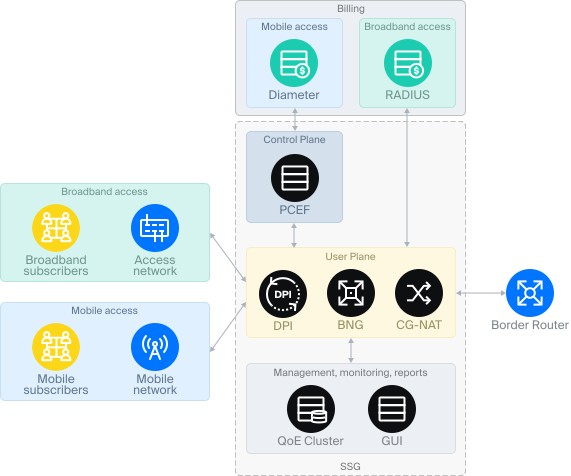
Figure 1 — Diagram of a convergent core
How the parts fit together:
- Access. Broadband subscribers arrive through the ISP’s access network; mobile subscribers arrive through the host MNO’s radio network.
- User plane. DPI, BNG and CG-NAT process traffic from both access types, then hand it to the border router.
- Control plane. PCEF applies mobile policies and talks to mobile billing over Diameter. Broadband sessions are authorised and charged over RADIUS.
- Management. The QoE cluster and GUI give one view of quality, usage and reports across fixed and mobile.
Building the core on a DPI engine brings practical benefits:
- Fewer boxes. One platform replaces a set of separate network appliances, which simplifies operations and scaling.
- Service-aware policies. Prioritisation of video, gaming and web traffic; zero-rating of messengers or local resources; whitelists by hostname or URL; HTTP redirect; a Mini-Firewall service.
- Custom protocols. New traffic classes can be defined by IP, CIDR, port, AS number or TLS SNI.
- Network fit. BGP, OSPF, VRF and ECMP; dual-stack IPv4/IPv6; in-line or on-stick deployment with LAG to save core ports.
- Scale. Models range from SSG-40 (20 Gbps, about 20,000 subscribers) to SSG-800 (400 Gbps, about 300,000 subscribers), with an average latency of about 30 µs.
The mobile stack has grown step by step: mobile network support in 2020, ePDG for Wi-Fi Calling in 2023, PCEF and Diameter in 2024, PGW in 2025, and PCRF and TWAG in 2026.
Consumer bundles or business private APN: two ways to launch mobile
Scenario 1: consumer MVNO. The ISP sells family bundles of home broadband plus mobile lines. It can start as a light MVNO on rented resources, or go straight to a full MVNO with Stingray and partner components for billing, OCS, HSS and MME.
Scenario 2: private APN for business. The target is companies with 100 or more employees that already pay for corporate mobile. The operator sells one package: office internet and a cloud PBX, plus mobile lines for staff. The business customer gets:
- VoLTE, Wi-Fi Calling and Wi-Fi Offload
- Policies, quotas and usage statistics across every employee device
- Employee location services (LBS)
- SMS notifications to staff
- eSIM with instant activation
How does an ISP launch as an MVNO: step by step
- Choose the model. Start as a Light MVNO to test demand, or go straight to a Full MVNO if the ISP needs its own tariffs, quotas and QoS from day one.
- Agree terms with a host MNO. Commercial terms with the host operator are one of the hardest parts of the launch.
- Design the bundle. Combine home broadband with mobile lines and add non-price perks, such as a home speed boost, prioritised gaming or video, or zero-rated messengers, instead of relying on discounts alone.
- Integrate billing and support. Broadband sessions are authorised and charged over RADIUS, mobile sessions over Diameter; the subscriber should still get one bill and one support line.
- Launch light and measure. Track churn and revenue per household for bundle customers against single-service customers.
- Bring the core in-house. When scale justifies it, move to a Full MVNO: PGW with PCEF, PCRF, OCS, HSS and MME.
What are the risks of becoming a convergent operator?
- Margin erosion. Analysys Mason warns that deep fixed-mobile discounts can erode margins and points to non-monetary perks as the better lever.
- Dependence on the host. In the Light MVNO model, control over tariffs and QoS is limited to what the host MNO offers.
- Integration effort. The hard parts are commercial terms with the host MNO and systems integration, not the radio network.
- Upfront cost of a Full MVNO. Running your own core network requires higher investment in core functions and IT integration.
Conclusion
For a regional broadband provider, adding mobile through an MVNO is now the most direct way to protect its base and grow revenue per household. The hard parts are commercial terms with the host MNO and systems integration, not the radio network.
A provider that already uses Stingray has the foundation of a convergent core. It can start as a Light MVNO and move to Full MVNO without replacing its infrastructure.
How to build a mobile operator in 2026?
FAQ
Can an ISP become an MVNO without building a mobile network?
Yes. The ISP rents radio coverage from a host mobile operator and keeps its own brand, product and customer relationship.
What is the difference between a Light MVNO and a Full MVNO?
A Light MVNO relies on the host operator’s radio, core and SIMs; it owns the brand, product, bundles and customer care, with tariff and QoS control limited to what the host offers. A Full MVNO runs its own packet core, policy, charging and subscriber database and uses the host only for radio access.
What core network functions does a Full MVNO need?
A PGW with PCEF for traffic and policy enforcement, a PCRF for policy decisions, an OCS for real-time charging, an HSS for the subscriber database and an MME for signalling and authentication.
Is churn lower for fixed-mobile customers?
In Swisscom’s 2018 data, annual churn was 5.4% for fixed-mobile customers, against 7.5% for mobile contract customers and 8.8% for fixed customers. Analysys Mason notes that deep bundle discounts can erode margins.
Can one platform serve both broadband and mobile subscribers?
Yes. Stingray Service Gateway processes fixed and mobile traffic through the same user plane: DPI, BNG and CG-NAT handle both access types, PCEF applies mobile policies over Diameter, and broadband sessions are authorised and charged over RADIUS.
Which parts of a Full MVNO core does VAS Experts provide?
We cover the packet core and policy layer with Stingray Service Gateway. The remaining components, including billing, OCS, HSS and MME, we deliver together with our partner MIATEL.