
Evolution of Operator Models
Historically, the basic model in the mobile industry has been the MNO (Mobile Network Operator) — an operator that owns its radio network, spectrum, and core network. This is the classic infrastructure-based model that assumes full control over the network and service quality.
However, it also has significant limitations. Obtaining spectrum requires substantial investment, building a radio network is a long and capital-intensive process, and industry regulation in most countries remains quite strict. As a result, in many markets the number of MNOs stabilized: few new players entered the market, while existing operators focused mainly on network modernization and service development.
Against this backdrop, an alternative model emerged in the late 1990s — the MVNO (Mobile Virtual Network Operator), where virtual operators provide mobile services using the radio access network of an existing MNO.
As the model evolved, several maturity levels emerged within the MVNO ecosystem, differing in the degree of control over network infrastructure and services.
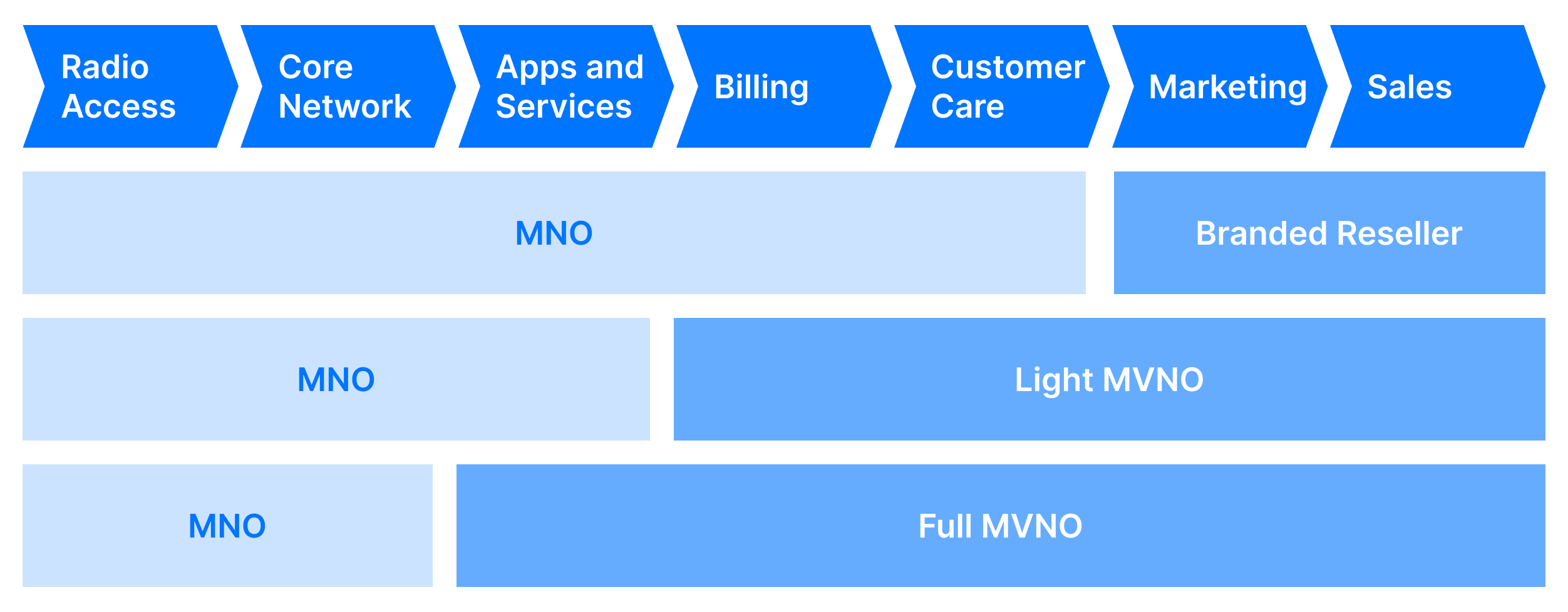
The simplest format is the Branded or Reseller MVNO, where the company essentially focuses on branding and sales, while the technical infrastructure remains on the host operator’s side.
The next level is the Light MVNO, where the operator introduces its own billing, CRM, and product logic control.
Finally, there is the Full MVNO — a model with its own core network and service architecture while still using the MNO’s radio access network. This format provides the highest level of independence in managing services and economics.
A separate segment consists of MVNE and MVNA — companies that provide infrastructure for launching virtual operators. Their role has grown alongside the increasing number of MVNOs: they reduce the technical barrier to entry, but also introduce dependency on a platform intermediary.
Now let’s take a brief look at the history and see how the MVNO model evolved from its earliest experiments.
Evolution of the MVNO Market
The Emergence of the MVNO Model
The mobile virtual network operator model began to take shape in the late 1990s in developed European markets. Its core idea was that a company could provide mobile services using the infrastructure of an existing operator without building its own radio network or owning spectrum.
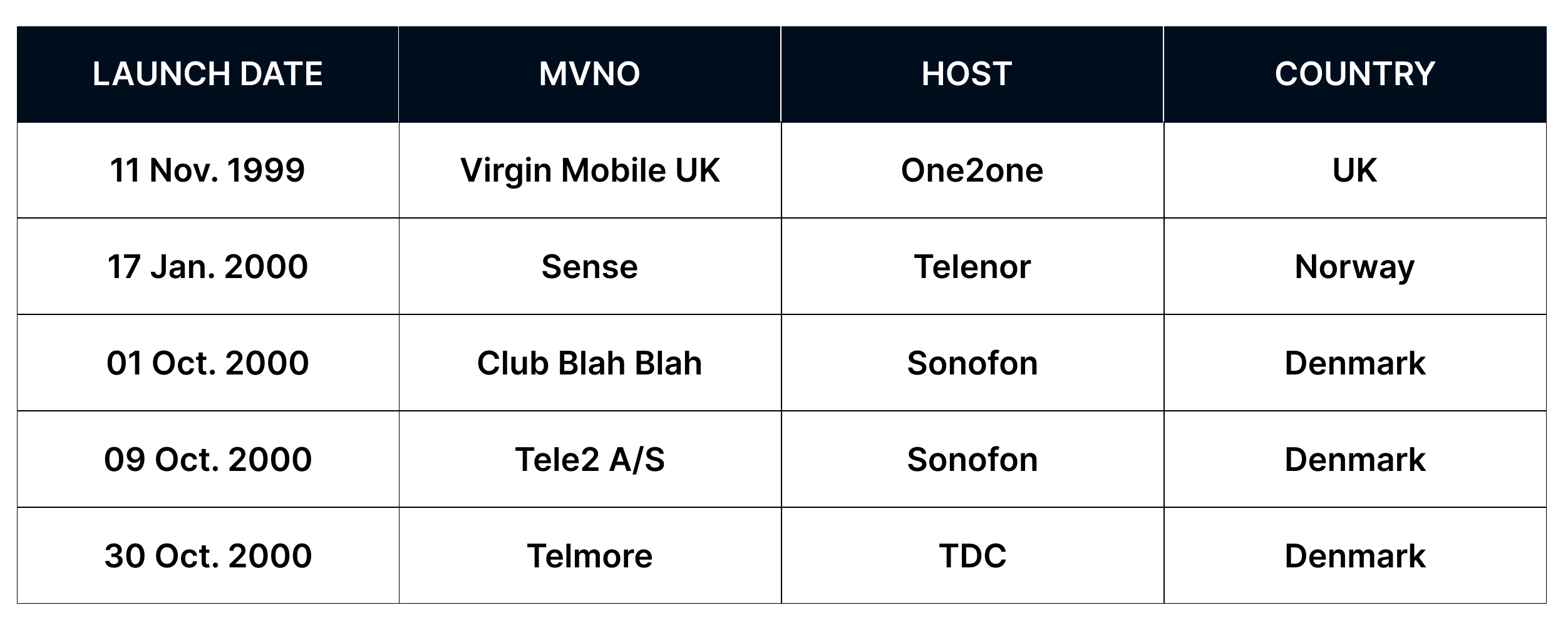
One of the first successful projects was Virgin Mobile in the United Kingdom. The company launched in 1999 on the One2One network and became one of the earliest examples of a successful MVNO brand built around targeted marketing and tariff strategies.
Soon after, the first Scandinavian MVNOs appeared: Sense Communications in Norway launched on the Telenor network in January 2000, while in Denmark in October 2000 Club Blah Blah (CBB Mobil), Tele2 A/S, and Telmore became the country’s first virtual operators.
In parallel with Europe, the virtual operator market also began to emerge in the United States, although the MVNO model developed along a different trajectory there. Unlike Europe, where MVNOs were often built around marketing and brand strategies, in the U.S. virtual operators became a tool for expanding the prepaid segment.
One of the most successful examples was TracFone, which actively sold low-cost phones and prepaid plans through major retail chains, and already served around 21 million subscribers in the 2010s. This retail distribution model focused on prepaid services made TracFone the largest MVNO in the U.S. market.
By the end of the decade, the MVNO market had moved beyond the experimental stage and became a stable part of the mobile industry. According to industry analytics, by 2010 there were more than 600 virtual operators worldwide, operating on the networks of traditional mobile companies.
Scaling of the MVNO Model
The growing penetration of smartphones, the expansion of 4G networks, and regulatory policies aimed at increasing competition led to the launch of virtual operators not only in Europe and the United States, but also in Asia, the Middle East, Africa, and Latin America.
In Asia, the virtual operator market began growing actively in the second half of the 2010s, particularly after regulatory liberalization. In Japan, so-called “cheap SIM” operators became widespread — MVNOs offering low-cost tariffs on the networks of major mobile carriers. One of the largest examples is IIJmio, launched by the internet provider Internet Initiative Japan.
At the same time, a new category began to grow rapidly — corporate and ecosystem MVNOs. Banks, fintech companies, and online services started using the virtual operator model as part of their product ecosystems. For example, the Japanese company Rakuten initially launched an MVNO service and later began deploying its own mobile network based on that experience, gradually transitioning toward the model of a full mobile operator.
In Latin America, MVNOs gained new momentum after telecommunications reforms in Mexico in 2014. A key milestone was the launch of the national wholesale network Red Compartida in 2018, which enabled many new virtual operators to offer flexible tariffs across the country.
In the Middle East, the MVNO market began forming in the 2010s when countries in the region started issuing licenses for virtual operators. One of the first and most successful examples was Virgin Mobile Saudi Arabia, launched in 2014 with a fully digital service model.
On the African continent, MVNOs began appearing around the mid-2010s. In South Africa, virtual operators are often closely linked to financial services. For example, FNB Connect, launched by First National Bank, integrates mobile connectivity with the bank’s digital ecosystem. Another example is Capitec Connect, an MVNO launched by Capitec Bank with affordable tariffs and digital services.
By the early 2020s, the MVNO model had become a fully established part of the global telecom industry, and the market had diversified into several formats:
- brand MVNOs (media companies, retailers, online services), for example Tesco Mobile in the United Kingdom;
- corporate MVNOs for banks and ecosystems, such as FNB Connect mentioned earlier;
- IoT operators serving connected devices and sensors, for example KORE Wireless (IoT-MVNO);
- digital MVNOs operating entirely through mobile apps without physical retail locations, such as Google Fi.

At the same time, the number of MNOs remained roughly in the same range — around 850–950 operators worldwide. On average, each of them hosts about 2.4 virtual operators, clearly illustrating how widespread the MVNO model has become today.
In the next article, we will take a closer look at other current trends and technologies and explain how to build a mobile operator in 2026.