
Until recently, there were only two options — a national (or perhaps even international) operator, or a regional one, depending on the founder’s administrative resources and investment capacity. All these operators competed for spectrum, built base stations (the more, the better), and sold minutes and megabytes to the same people. Huge investments, long construction times, and a very limited set of telecom equipment manufacturers. Competition existed, but entering this market was extremely difficult. That’s the image we remember. What could possibly go wrong?
Today, thousands of new operators have emerged worldwide, built on entirely different business logic. For example:
- Large banks and retailers are creating ecosystems around their customers, collecting big data on their preferences.
- Internet providers want to leverage their infrastructure to offer bundled mobile services to subscribers.
- Millions of migrants need service in their native language and affordable connectivity to their home countries.
- Even in a remote mine deep in the tundra, connectivity is required.
- Thousands of robots in various locations need to be managed…
Rapid deployment and flexible infrastructure with modest investments to solve a wide range of use cases — that is the reality of modern telecom. How did this become possible?
Sharing Economy and MVNO
It turns out that obtaining spectrum and building your own base stations is no longer necessary. Nor is buying a network core (EPC) at the price of a Caribbean island. Any infrastructure can be rented. The only requirements are having a strong business model and being able to sell connectivity to subscribers under your own brand. This model is called a virtual operator (MVNO). In this way, the trendy concept of the “sharing economy” has entered telecom: hundreds of operators can operate on a single network and infrastructure.
You can experiment with bold business ideas and gradually build the necessary pieces of infrastructure as your business grows. To get started, an investment of just a few thousand dollars in marketing (as a reseller or light MVNO) is enough, while a Mobile Virtual Network Enabler (MVNE) can assist with the technology and launch. The choice of an MVNE should also depend on your specific needs and the cost of “entry”.
And if the idea takes off and achieves significant reach, you can move to a full MVNO — or even aim to build the infrastructure of a new MNO.
Infrastructure Virtualization
Even a beginner operator can’t do without a foundation — data centers with servers where its information systems run. And in this “conservative, hardware-heavy” world, there are some interesting “cloud” hacks:
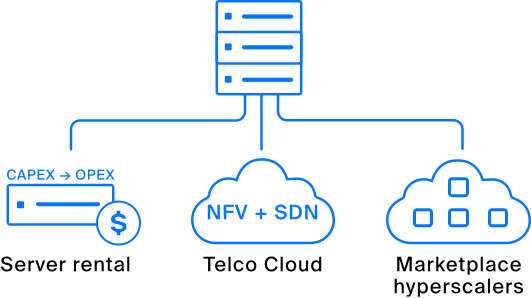
- Servers don’t have to be bought — they can be rented, reducing the load on your own IT and shifting CAPEX to OPEX.
- Specialized Telco Clouds with NFV (network function virtualization) and SDN (software-defined networking) are being created specifically for telecom.
- Hyperscalers on marketplaces provide ready-made operator infrastructure or individual information systems, requiring only minor configuration. Such services are offered by HP, AWS, Azure, and others.
These new technologies make it possible to save significantly on hardware during growth and avoid the risks of being tied to a single vendor.
Proprietary Systems vs. “Independent Telecom Software”
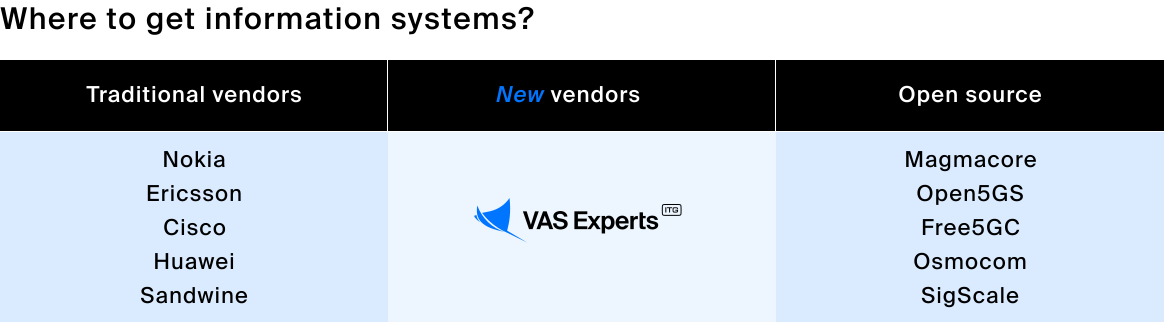
For a full MVNO, you need to select a set of information systems — from EPC to billing. The emergence of hundreds and thousands of new operators has changed the approach to building these systems. The era of proprietary systems (PAKs) with astronomical requirements for standardization, scalability, and fault tolerance from established vendors is giving way to new vendors and even open-source enthusiasts.
“Building a GSM or LTE mobile operator on a table using just a laptop and a cheap SDR (Software-Defined Radio) board?” Unthinkable just 10 years ago, it is fully possible in 2026 — there are numerous articles documenting real experiments. Such an “operator” based on open-source software can handle voice communication and provide internet at home or in the office. Several platforms already exist, they are actively developing, and they can be used both for the developers’ own purposes and to solve real-world problems for small operators. Notable examples include Magma Core, Open5GS, Free5GS, and others. Of course, open-source software requires proper setup and cannot always be used commercially, but its potential is undeniable.
So what should the hundreds of growing operators do, who cannot afford the “gold-plated” proprietary systems from telecom giants but have outgrown open-source solutions? In recent years, “new” vendors have emerged for them, operating as ISVs (Independent Software Vendors) and providing the full range of software needed to launch LTE/5G networks. Good examples include IPLOOK and VAS Experts.
RAN LTE, RAN 5G!
So, our operator has grown enough to consider acquiring base stations (Radio Access Network – RAN). In 2026, everyone is still building LTE networks, but there are active plans to launch 5G and 5G SA. Since RAN requires enormous effort and investment, several technological factors should be taken into account:
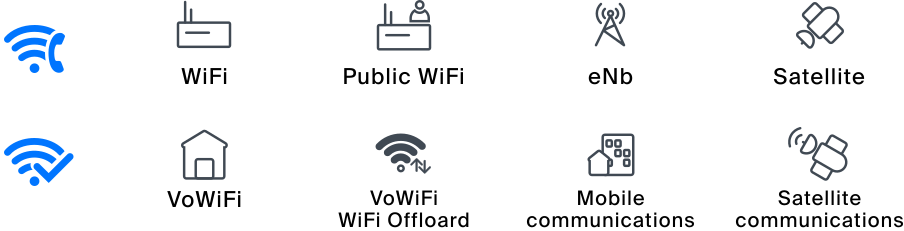
- WiFi coverage and speeds are increasing in cities. At work, at home, and in most public places, subscribers use WiFi for data and voice via WiFi Calling.
- Many modern smartphones already support satellite connectivity. For now, this is limited to SMS, but voice calls and internet are expected within 2–5 years. And who knows — will your operator launch 5G SA before full satellite connectivity from, say, Elon Musk?
- eSIM and messaging apps. Subscribers are increasingly less tied to their operator and can switch in a minute without visiting an office for a new SIM card. A phone number is becoming less important than a messenger nickname.
But building a network isn’t enough — let’s not forget the “hidden iceberg” beneath: acquiring spectrum, obtaining numbering, licensing, and certifications. The operator also bears the burden of supporting numerous government systems. The more proprietary systems an operator has, the heavier the regulatory burden from the state.
Back to Business
Our brief review of technologies for mobile operators allows us to draw several conclusions:
- Launching a new operator in 2026 has become relatively simple from a technological standpoint. This is why dozens of MVNOs are emerging, some of which will find successful business niches at the intersection of telecom and other industries (banks, retail, IoT, etc.). Business ideas are driving telecom forward, while subscribers benefit from higher-quality and more affordable connectivity through complementary products.
- A wide variety of business models are being applied, with both direct and indirect revenue streams. Banks and retailers profit by closing their ecosystems and accumulating customer big data, broadband operators offer long-awaited convergent services and retain subscribers, and niche corporate plans can even be quite profitable.
- It is unlikely that new host operators will appear in the near future. The entry barrier remains very high, given the ongoing generational race in network technologies and the threat of disruptive innovations.
- Although not covered in our review, regulatory pressure in the industry is generally increasing. In countries where regulatory balance is not maintained, growth may slow, and market monopolization could occur, to the detriment of subscribers.