
Challenges
For many years, subscriber management and traffic control functions were handled by Cisco SCE 8000 platforms. The infrastructure included 32 appliances responsible for subscriber policy enforcement and bandwidth management. As broadband speeds increased beyond 300 Mbps and traffic volumes continued to rise, the limitations of the existing platform became more apparent. The system struggled to provide accurate traffic control at higher speeds, while scaling the infrastructure required additional hardware and increased operational effort.
The operator also faced growing pressure from IPv4 address exhaustion. Existing NAT mechanisms were no longer sufficient for the scale of the network, making the deployment of a carrier-grade CG-NAT platform a strategic requirement.
At the same time, the operator wanted to preserve its existing operational processes and maintain integration with its in-house billing platform without major changes to the OSS/BSS environment.
Selecting a New Platform
To modernize the network, the operator selected Stingray with integrated BNG and CG-NAT functionality.
One of the key advantages of the platform was its ability to combine multiple network functions within a single software solution. Rather than maintaining separate systems for subscriber management, traffic visibility, and NAT services, the operator could consolidate these capabilities into a unified architecture running on commodity x86 hardware.
The platform also offered flexible integration options, support for high-speed broadband services, horizontal scalability, and the ability to build resilient network designs without relying on complex external mechanisms.
Deployment
The modernization project covered both subscriber management and NAT infrastructure.
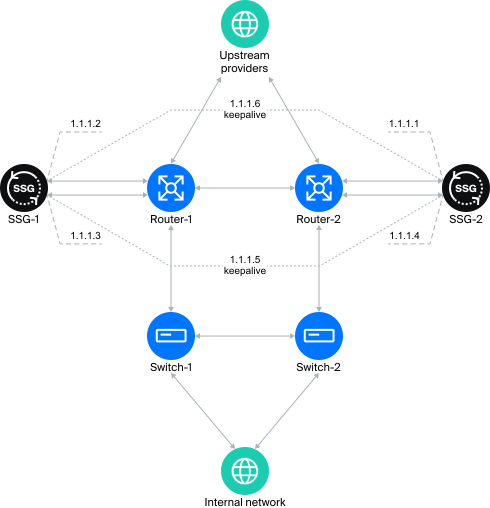
For subscriber services and traffic analytics, eight Stingray-80 servers were deployed across several network locations. The environment was designed as a fully routed Layer 3 architecture without Layer 2 stretching between sites, simplifying scaling and improving overall resilience.
Subscriber sessions can be processed by any available server, while traffic distribution is handled through routing. This approach allowed the operator to replace 32 legacy Cisco SCE appliances with just eight Stingray servers while maintaining performance and service continuity.
Within this architecture, Stingray BNG is responsible for subscriber session management, service plan enforcement, traffic policing, traffic classification, and network analytics.
A major requirement during the project was preserving the existing billing environment. To achieve this, the operator implemented a push-based integration model. A custom API component transfers subscriber parameters directly from the billing system to Stingray servers, allowing the operator to retain established operational workflows without introducing a traditional PCRF layer.
The introduction of carrier-grade NAT became a critical part of the modernization effort as available IPv4 resources approached exhaustion.
The solution was implemented using an On-Stick architecture, enabling predictable traffic handling without dependence on specific physical interfaces. Subsequent support for LACP further simplified high-availability configurations and provided additional flexibility for future expansion.
The resulting platform delivers integrated subscriber-aware NAT processing while remaining tightly connected with BNG and traffic management functions. This creates a more streamlined operational model and provides a solid foundation for continued network growth.
In critical scenarios, bypass technology helps preserve network availability and minimize service disruption for end users.
Results
The migration to Stingray enabled the operator to modernize its broadband infrastructure and eliminate dependence on legacy Cisco SCE hardware. The new platform supports modern broadband speeds without the limitations of the previous environment while providing a fully integrated carrier-grade CG-NAT solution. Consolidating multiple functions within a software-based architecture reduced hardware requirements, lowered power consumption, and significantly decreased the physical footprint in data centers.
At the same time, the operator gained a scalable platform capable of supporting future subscriber growth and the introduction of new services without major architectural changes.
Future Development
The operator continues to expand its network and plans to increase infrastructure capacity through the adoption of 100G connectivity and additional server resources.
Further optimization is expected through tighter integration of BNG and CG-NAT functions within the same platform. The company is also evaluating the deployment of advanced Quality of Experience (QoE) analytics.
The planned QoE framework will correlate data from network infrastructure, customer devices, service interactions, and support systems to provide a comprehensive view of service quality from the subscriber’s perspective. This will allow operational teams to identify issues proactively, resolve potential problems before they affect customers, and improve overall service quality through data-driven decision making.
Customer Feedback
The migration from Cisco SCE to Stingray delivered the scalability required for modern broadband services while reducing infrastructure complexity and resource consumption. Flexible billing integration and the ability to deploy a high-availability CG-NAT solution within a unified platform were among the key benefits of the project.