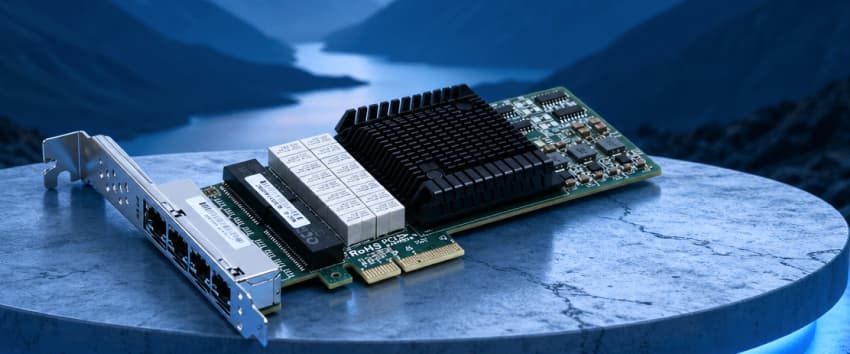
Why LR-LINK
Not so long ago, when building DPI nodes and other high-load network solutions, the choice of cards with hardware Bypass was quite limited. Silicom solutions, which have long proven themselves in operator networks, were most commonly used.
Recently, LR-LINK has become one of the most popular manufacturers of network cards for telecom infrastructure. The reason is simple — the cards are built on proven Intel chipsets, demonstrate stable performance under high load, and are significantly more affordable than many specialized solutions. As a result, they are increasingly chosen by internet service providers and telecom operators when building new nodes and modernizing existing networks.
Why hardware Bypass is needed
Hardware Bypass is used in Stingray DPI when installed in in-line mode on the network, and all user traffic passes through it. Bypass is implemented on built-in cards and on an external Bypass switch.
If equipment needs to be taken out of service for maintenance, a power outage occurs, there is a hardware failure, or a software error, the card automatically switches the interfaces to bypass mode. Traffic continues to be transmitted directly, so connectivity is not interrupted even if the server becomes unavailable.
The full list of equipment and card requirements is available in the documentation.
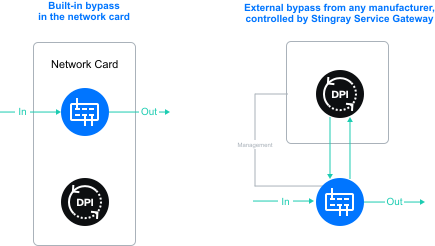
Previously, hardware Bypass was supported in our solutions only for Silicom network cards. Network adapters with throughput of 1GbE, 10GbE, 40GbE, and 100GbE are available for them, allowing use both in small networks and on high-load backbone nodes.
This capability is now also implemented for LR-LINK (1GbE, 10GbE, 25GbE). Operators can use a wider range of equipment, select the optimal configuration for the requirements of each project, and maintain network fault tolerance.